


Aether Coffee Roasters
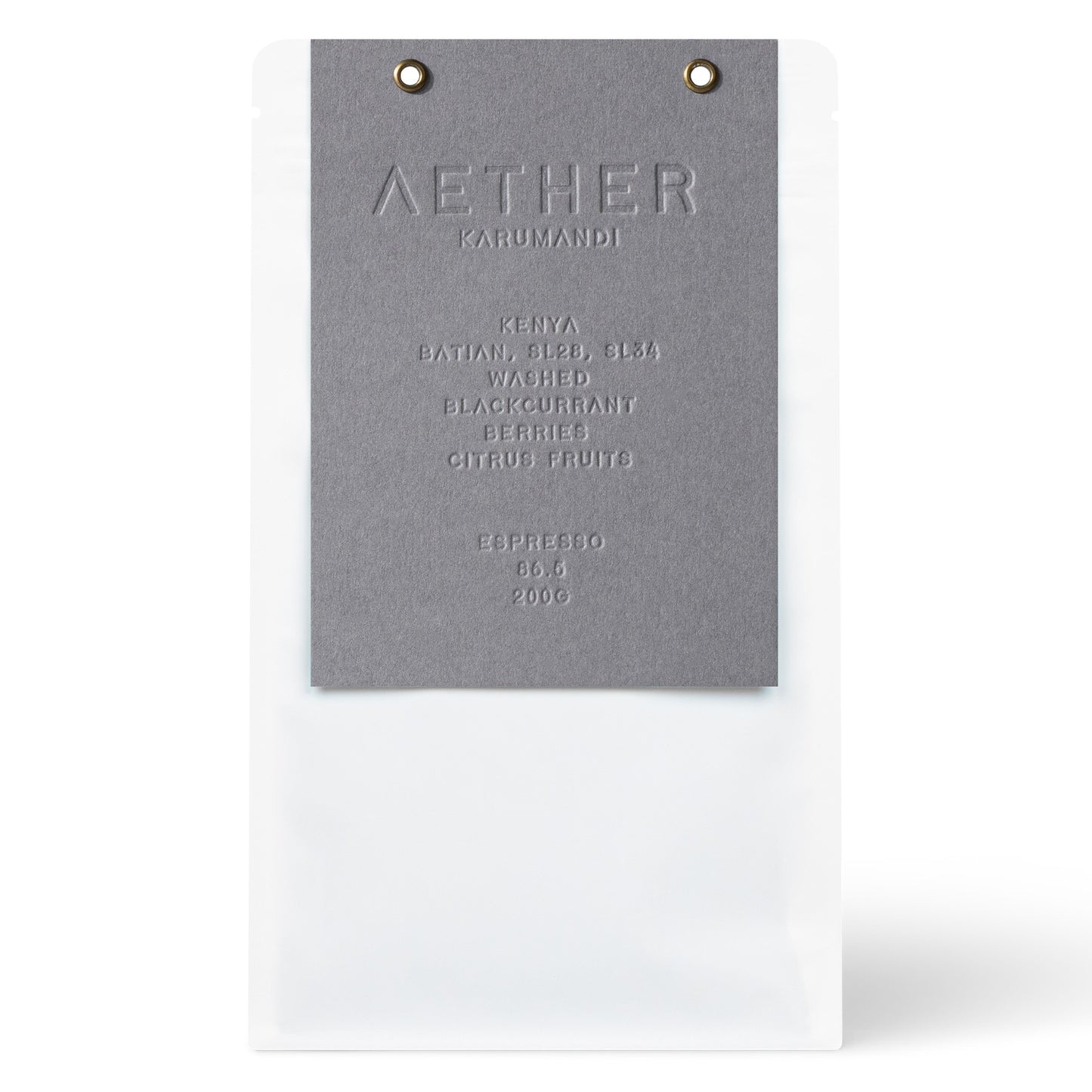
Kenya - Karumandi - Washed
Kenya - Karumandi - Washed
Couldn't load pickup availability
Share
Kenya - Karumandi - Washed
Flavour Notes: Blackcurrant - Berries - Citrus Fruits
This coffee is produced at Karumandi Factory, a wet mill operating under the Baragwi Farmers Cooperative Society (FCS), one of the oldest and most respected coffee cooperatives in Kenya. Karumandi Factory draws on decades of experience within Baragwi FCS to consistently deliver high-quality lots that showcase the vibrant acidity, layered fruit sweetness, and dynamic clarity Kenyan coffees are renowned for.
Baragwi FCS was registered in 1953 and today manages 12 wet mills across Kirinyaga County, supporting more than 16,800 registered members. Approximately 1,700 smallholder farmers deliver cherries to the Karumandi Factory. The cooperative’s core mission is to promote the social and economic wellbeing of its members while ensuring access to competitive market prices for their coffee. Baragwi FCS employs a workforce of 137 staff members, with women representing roughly 23 % of the team.
Farmers supplying Karumandi typically cultivate small plots averaging around 300 coffee trees each. These farms are situated at elevations between 1,700 and 1,800 metres above sea level in the Kirinyaga subregion of Kenya’s Central Region. The main varieties grown include SL28, SL34, Batian, and Ruiru 11 a mix that contributes both complexity and structural sweetness in the cup.
The Process Unveiled:
1. Harvesting: Ripe cherries are selectively handpicked by more than 1,700 smallholder farmers delivering fruit to Karumandi Factory at elevations of 1,700–1,800 masl. Farmers typically manage small plots with ~300 trees each.
2. Intake & Sorting: Cherries are received at the wet mill and visually hand-sorted to remove underripe, overripe, or damaged fruit, ensuring only high-quality cherries proceed to pulping.
3. Pulping & Density Separation: Cherries are depulped shortly after arrival, then undergo density grading in water channels to separate heavier, mature coffee from lower-density material.
4. Fermentation: Pulped parchment undergoes controlled wet fermentation for approximately 12–24 hours. Endogenous enzymes break down remaining mucilage, enhancing clarity and bright acidity typical of fully washed Kenyan coffees.
5. Washing & Soaking: Following fermentation, the parchment is thoroughly washed through clean water grading channels. It is then soaked in circulating clean water for around 24 hours — a practice that helps manage drying bed availability while contributing to overall cup stability and longevity.
6. Drying (Raised Beds): Washed parchment is transferred to raised drying beds where it is spread in even layers. Over the 10–20 day drying period, the coffee is regularly turned and shaded as needed to promote uniform drying and prevent uneven moisture loss.
7. Drying Management & Final Stabilisation: Drying continues until moisture levels reach a stable range suitable for milling and export. This meticulous drying supports structural sweetness, brightness, and clarity — all hallmarks of a high-quality AA-grade Kenyan coffee.


Details
Delivery
We roast our coffee every Tuesday and Wednesday. If you're planning a large order, please reach out to us first.
For UK-based customers, enjoy free delivery on orders over £30. And for our international friends, we're offering free shipping on orders over £150.
In the UK, we ship with Royal Mail 24, and for the EU and the rest of the world, we use Royal Mail Standard Tracked shipping.
Collapsible row
In our quest to minimize emissions and ultimately become a carbon and energy-negative company, we're committed to roasting our coffee using electric roasters powered by renewable energy. Eventually every bit of energy we use, from the electricity powering our coffee roasters to the battery in the laptop used to write this message, will come from renewable sources.
At the moment, we're proud to say that 30-45% of the energy we use to roast our coffee is sourced from renewable energy.
Sustainability
We're deeply dedicated to sustainability, which is why our bags are 100% recyclable. They're free from any ink and glue, except for the non-toxic, biodegradable ink we use for the roasting date stamp.
Plus, we craft these bags without using any electricity, except for sealing them. Our bags are also resealable, making them perfect for multiple uses.